Software Oriented

Studying the Significance of Surge Impedance and the Surge Impedance Loading (SIL) of a Transmission Line

Aim

To model a medium transmission line using a nominal Pi model in MATLAB/Simulink and to study the significance of Surge Impedance Loadingsurge impedance loadingThe power delivered by a transmission line when terminated by its surge impedance. At this loading, the line produces exactly as much reactive power as it consumes, resulting in a flat voltage profile. (SIL). This experiment will help us analyze voltage and power profiles under the following loading conditions by varying the load resistance (ZL):
  • Loading at SIL (ZL = ZC)
  • Heavy Load / Over-Loaded (ZL < ZC)
  • Light Load / Under-Loaded (ZL > ZC)

Apparatus & Software

Sl. No.Apparatus / SoftwareTechnical SpecificationQuantities
1MATLAB/SimulinkR2023 or compatible1
2Simulink Library BrowserPower Systems Toolbox1
Simulink Components Used:
  • Three-Phase Source
  • Three-Phase V-I Measurement
  • Pi Section Line
  • Three-Phase RLC Branch
  • Powergui
  • RMS blocks, Displays, and Scopes
Line Parameters:
ParameterValue
Source Voltage (RMS, Line-to-Line)7 kV
Frequency50 Hz
Line Inductance per km2 × 10⁻³ H
Line Capacitance per km8 × 10⁻⁹ F
Line Resistance per km1 × 10⁻⁹ Ω
Line Length200 km
Resistance (R) is varied during simulation to observe its impact on voltage and power due to the losses in the line.

Theory

A transmission line has series inductance (L) and shunt capacitance (C). For a lossless line, the surge impedancesurge impedanceThe characteristic impedance of a lossless transmission line, calculated as the square root of the ratio of its series inductance to shunt capacitance (Zc = √(L/C)). or characteristic impedance is given by:
ZC=LCZ_C = \sqrt{\frac{L}{C}}
The surge impedance is given by the ratio of voltage to current for a traveling wave on the line. When the load impedance equals the surge impedance, there are no reflections in the wave and the line operates under natural loading conditions.
The surge impedance loading (SIL) is the amount of power delivered to a purely resistive load when ZL = ZC, and it is given by:
SIL=V2ZCSIL = \frac{V^2}{Z_C}
During this loading condition, the reactive power generated by the shunt capacitance is equal to the reactive power absorbed by the series inductance. This balance keeps the voltage constant along the line.
Effect of Loading on Line Behavior:
  • ZL > ZC (Load < SIL): The line behaves capacitively and supplies reactive power. Receiving end voltage will rise (VR > VS). Controlled using shunt reactors.
  • ZL = ZC (Load = SIL): Reactive power is balanced and voltage profile remains constant (VR ≈ VS).
  • ZL < ZC (Load > SIL): The line behaves inductively and absorbs reactive power. Receiving end voltage will fall (VR < VS). Controlled using shunt capacitors.
SIL serves as a benchmark for voltage stability and efficient power transfer in transmission systems.

Pre-Lab / Circuit Diagram

Core Simulink Model — Nominal Pi Transmission Line
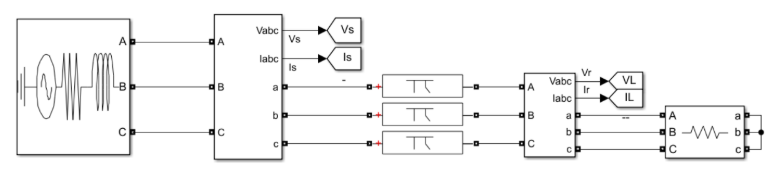
Figure 1: Simulink model of the medium transmission line using nominal Pi model
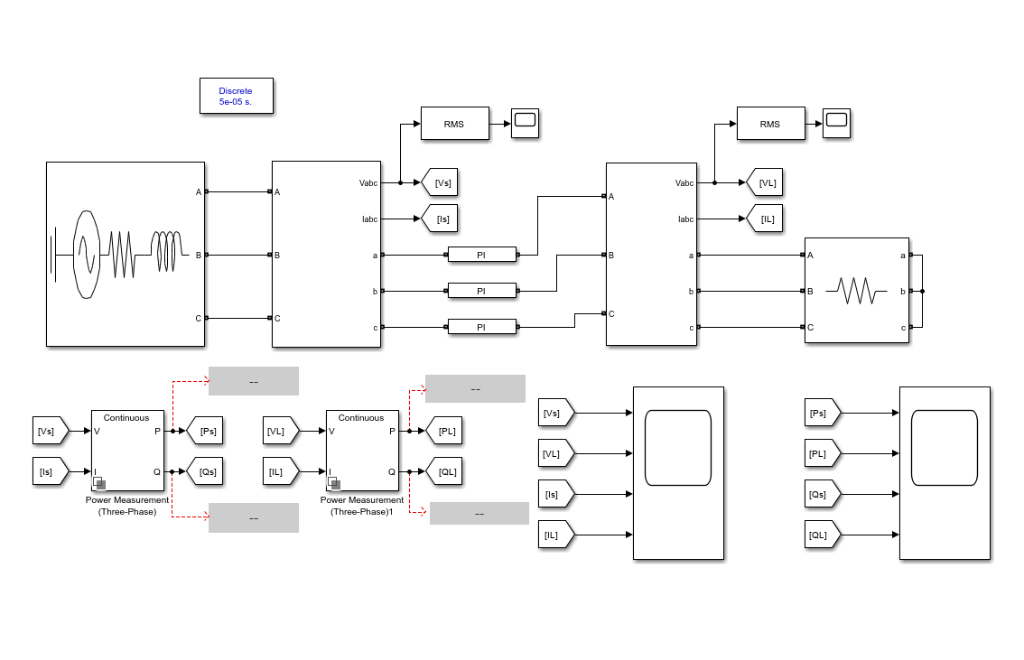
Figure 1: Simulink model of the medium transmission line using nominal Pi model

The above figure shows only the core Simulink model of the transmission line using the nominal Pi configuration. Other elements like measurement blocks, scopes, and display units are added later to observe the outputs.
Complete Simulink Setup
Figure 2: Complete Simulink setup of the medium transmission line model including measurement and display blocks

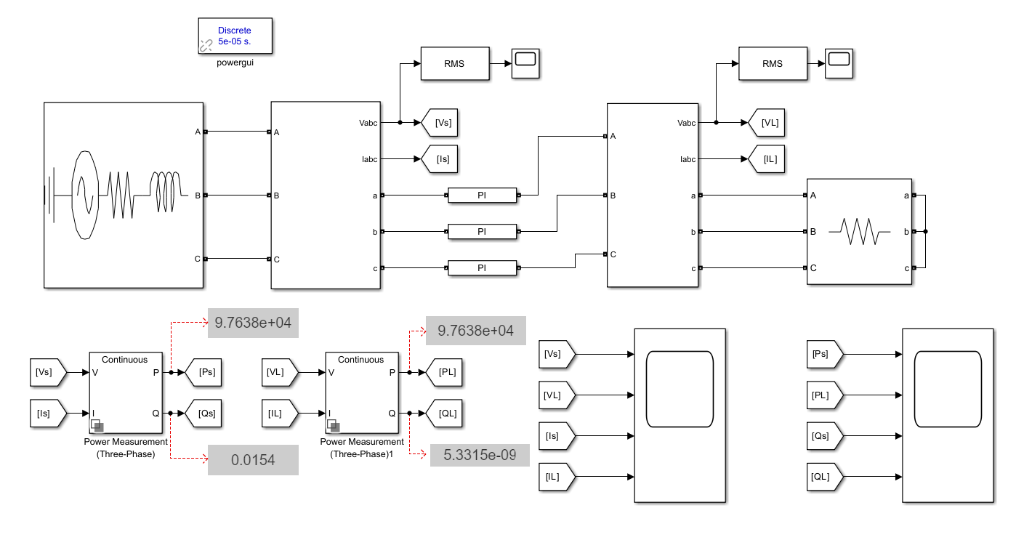
Figure 2: Complete Simulink setup of the medium transmission line model including measurement and display blocks

The above figure shows the complete Simulink model diagram of the medium transmission line using the nominal Pi configuration. In this setup, voltage and current goto blocks are connected at both sending and receiving ends along with scopes and display units to observe output voltages, current waveforms, and real and reactive power flow under various loading conditions.

Procedure

  1. Open MATLAB/Simulink and create a new model.
  2. Build the nominal Pi transmission line model using the Pi Section Line block with the given parameters.
  3. Connect a Three-Phase Source at the sending end with source voltage 7 kV (RMS, line-to-line) at 50 Hz.
  4. Connect Three-Phase V-I Measurement blocks at both sending and receiving ends.
  5. Connect Power Measurement (Three-Phase) blocks to measure active and reactive power at both ends.
  6. Connect RMS blocks to measure RMS values of voltages and currents.
  7. Add Scopes and Display blocks to observe the output waveforms and numerical values.
  8. Set the load resistance ZL = ZC = 500 Ω (SIL condition) and run the simulation. Record VS, VR, PS, PR, QS, QR.
  9. Change ZL = 100 Ω (heavy load, ZL < ZC) and run the simulation. Record the readings.
  10. Change ZL = 1000 Ω (light load, ZL > ZC) and run the simulation. Record the readings.
  11. Compare the voltage and power profiles across all three loading conditions and analyze the results.

Simulation / Execution

MATLAB/Simulink was used to simulate the medium transmission line under three loading conditions: loading at SIL (ZL = 500 Ω), heavy load (ZL = 100 Ω), and light load (ZL = 1000 Ω). The nominal Pi model was used with the parameters listed in the apparatus section.

Observations

The order of waveforms is the same for all loading conditions: sending end voltage, then receiving end voltage, followed by sending end current and receiving end current at the bottom. For power waveforms: sending end active power at the top, then receiving end active power, followed by sending end reactive power and receiving end reactive power at the bottom.
Case 1: Loading = SIL (ZL = 500 Ω)
Figure 3: Simulink model showing measured voltage, current, and power readings for loading condition ZL = ZC (Loading = SIL)
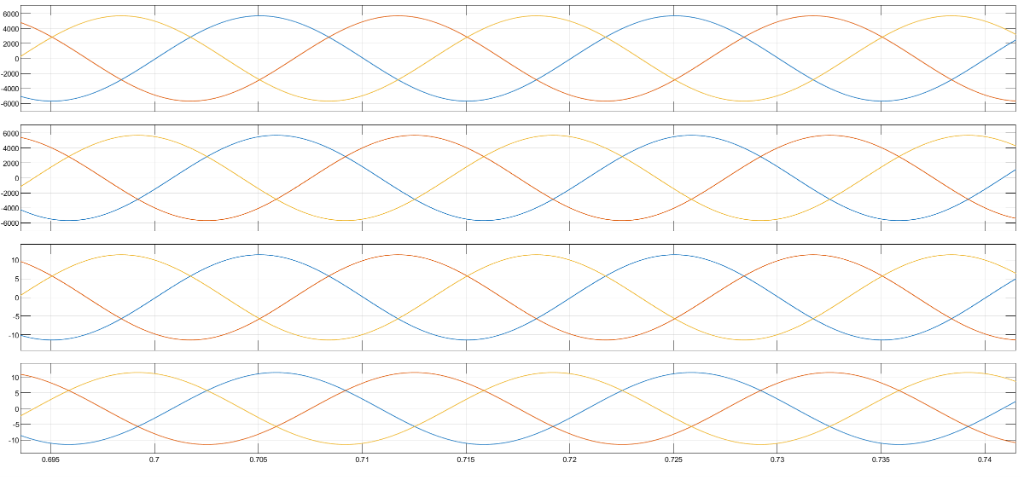
Figure 3: Simulink model showing measured voltage, current, and power readings for loading condition ZL = ZC (Loading = SIL)

Figure 4: Voltage and current waveforms for loading condition ZL = ZC
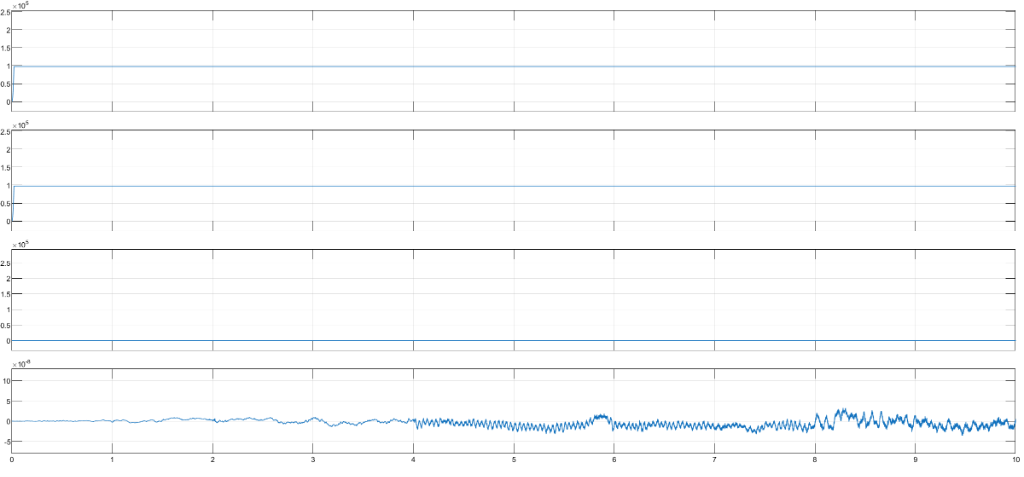
Figure 4: Voltage and current waveforms for loading condition ZL = ZC

Figure 5: Active and reactive power waveforms for loading condition ZL = ZC
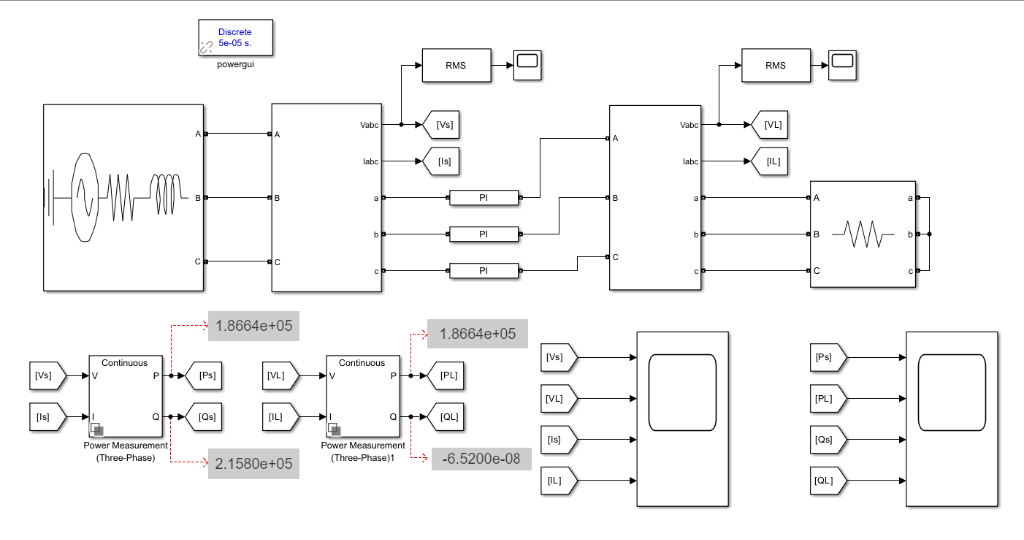
Figure 5: Active and reactive power waveforms for loading condition ZL = ZC

Case 2: Loading > SIL (ZL = 100 Ω)
Figure 6: Simulink model showing measured readings for loading condition ZL < ZC (Loading > SIL)
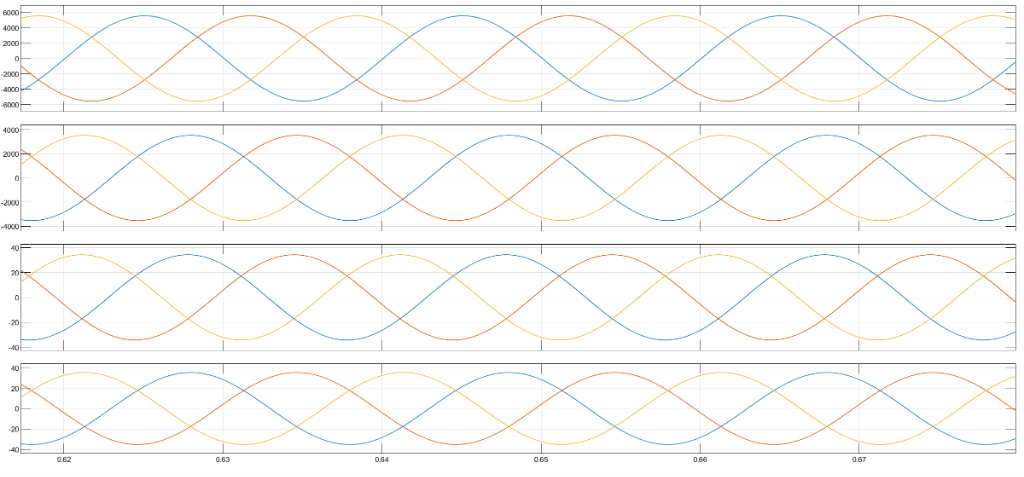
Figure 6: Simulink model showing measured readings for loading condition ZL < ZC (Loading > SIL)

Figure 7: Voltage and current waveforms for loading condition ZL < ZC
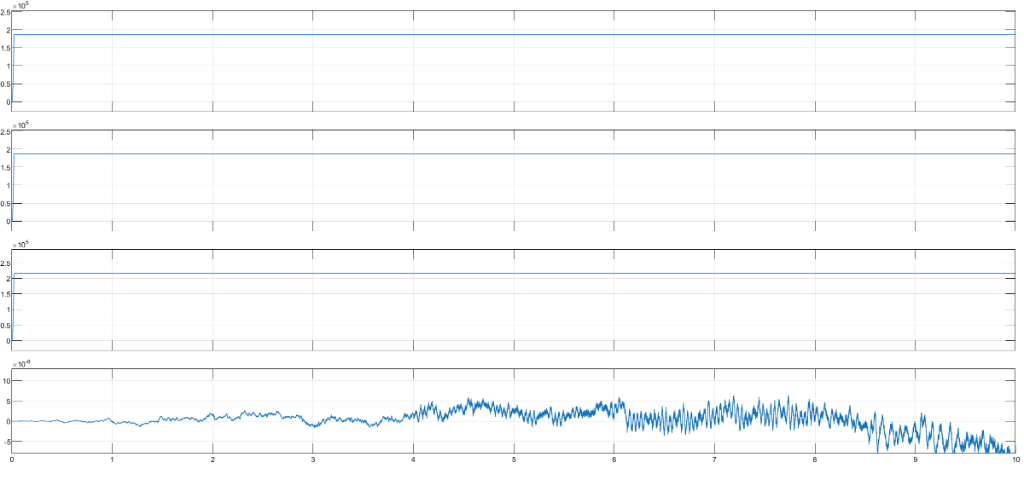
Figure 7: Voltage and current waveforms for loading condition ZL < ZC

Figure 8: Active and reactive power waveforms for loading condition ZL < ZC
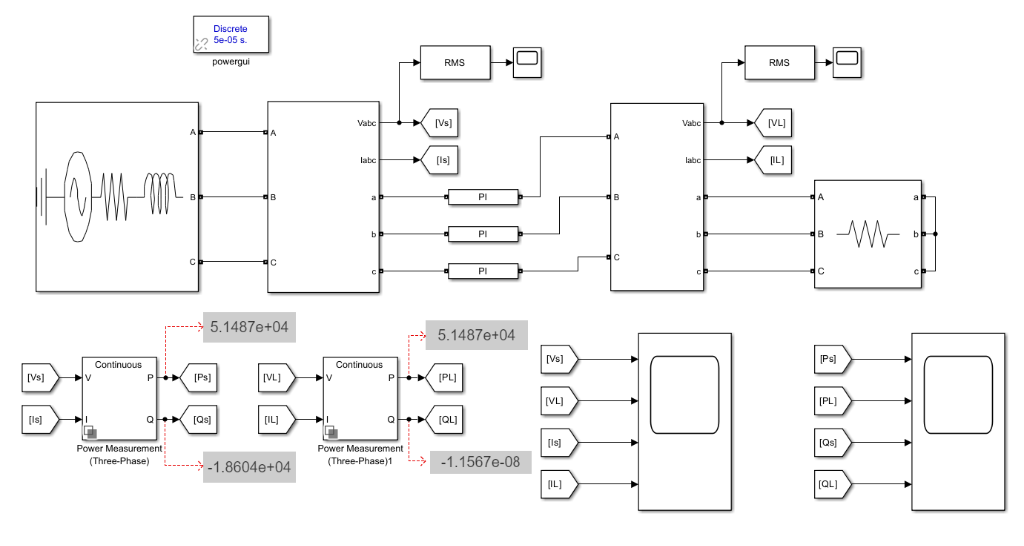
Figure 8: Active and reactive power waveforms for loading condition ZL < ZC

Case 3: Loading < SIL (ZL = 1000 Ω)
Figure 9: Simulink model showing measured readings for loading condition ZL > ZC (Loading < SIL)
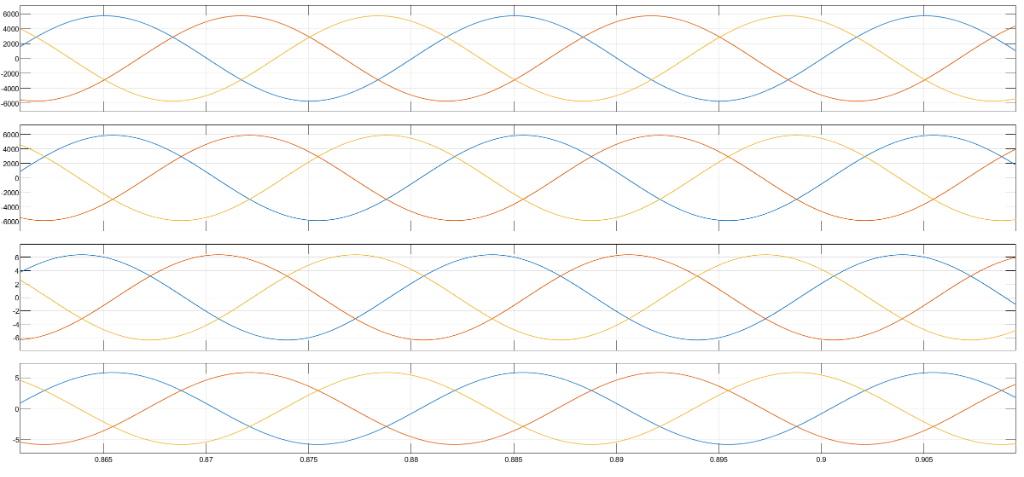
Figure 9: Simulink model showing measured readings for loading condition ZL > ZC (Loading < SIL)

Figure 10: Voltage and current waveforms for loading condition ZL > ZC
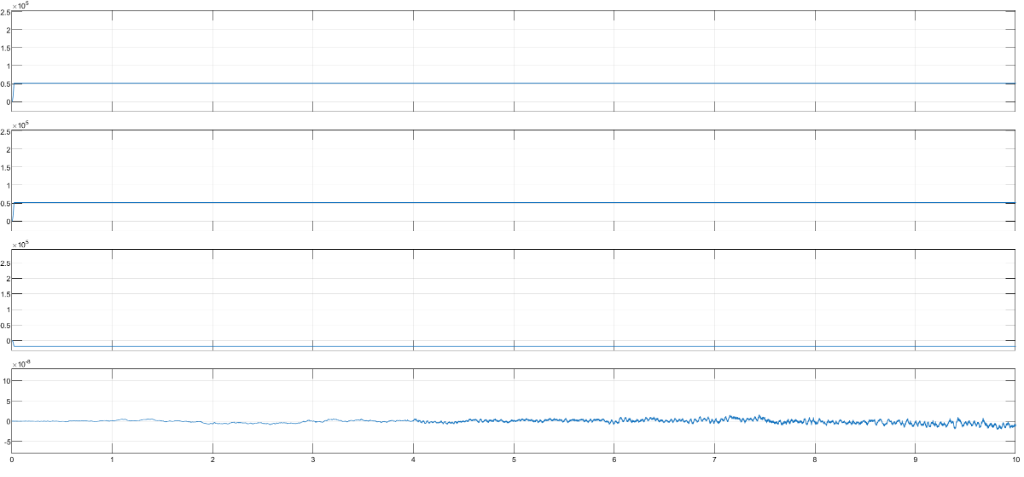
Figure 10: Voltage and current waveforms for loading condition ZL > ZC

Figure 11: Active and reactive power waveforms for loading condition ZL > ZC

Figure 11: Active and reactive power waveforms for loading condition ZL > ZC

Observation Table
Loading ConditionLoad (ZL)VS (kV)VR (kV)PS (MW)PR (MW)QS (Mvar)QR (Mvar)
Load = SILZL = 500 Ω4.03204.03200.09760.0976≈ 0≈ 0
Load > SILZL = 100 Ω3.93142.49420.18660.18660.2158≈ 0
Load < SILZL = 1000 Ω4.04554.14280.05140.0514−0.0186≈ 0

Calculations

Given: f = 50 Hz, L′ = 2 × 10⁻³ H/km, C′ = 8 × 10⁻⁹ F/km, ℓ = 200 km, VLL = 7 kV = 7000 V.
Total line inductance and capacitance:
L=L×=2×103×200=0.4 HL = L' \times \ell = 2 \times 10^{-3} \times 200 = 0.4 \text{ H}
C=C×=8×109×200=1.6×10⁶ FC = C' \times \ell = 8 \times 10^{-9} \times 200 = 1.6 \times 10^{-6} \text{ F}
Line reactance (series) for the whole line:
Xline=2πfL=2π×50×0.4=40π125.6637 ΩX_{line} = 2\pi f L = 2\pi \times 50 \times 0.4 = 40\pi \approx 125.6637 \text{ Ω}
Surge impedance:
ZC=LC=0.41.6×106=250000=500 ΩZ_C = \sqrt{\frac{L}{C}} = \sqrt{\frac{0.4}{1.6 \times 10^{-6}}} = \sqrt{250000} = 500 \text{ Ω}
Surge Impedance Loading (SIL):
SIL=V2ZC=(7000)2500=49,000,000500=98,000 W=98 kW=0.098 MWSIL = \frac{V^2}{Z_C} = \frac{(7000)^2}{500} = \frac{49{,}000{,}000}{500} = 98{,}000 \text{ W} = 98 \text{ kW} = 0.098 \text{ MW}
Solved Problems
Q1. A three-phase, 50 Hz transmission line has a per-kilometer inductance of 1.2 mH/km and a capacitance of 0.009 µF/km. The line operates at a line-to-line voltage of 220 kV. Determine: (1) The surge impedance of the line. (2) The surge impedance loading (SIL) in megawatts (MW).
Solution: Per-kilometer values given: L′ = 1.2 × 10⁻³ H/km, C′ = 0.009 × 10⁻⁶ F/km = 9 × 10⁻⁹ F/km, VLL = 220 × 10³ V.
Surge impedance:
ZC=LC=1.2×1039×109=1.33333×105365.15 ΩZ_C = \sqrt{\frac{L'}{C'}} = \sqrt{\frac{1.2 \times 10^{-3}}{9 \times 10^{-9}}} = \sqrt{1.33333 \times 10^5} \approx 365.15 \text{ Ω}
Surge Impedance Loading (SIL):
SIL=VLL2ZC=(220×103)2365.15=48,400×104365.151.325×108 W132.55 MWSIL = \frac{V_{LL}^2}{Z_C} = \frac{(220 \times 10^3)^2}{365.15} = \frac{48{,}400 \times 10^4}{365.15} \approx 1.325 \times 10^8 \text{ W} \approx 132.55 \text{ MW}
Q2. A three-phase, 50 Hz transmission line has a per-kilometer inductance of 4.2 mH/km and a capacitance of 0.027 µF/km. The line operates at a line-to-line voltage of 440 kV. Determine: (1) The surge impedance of the line. (2) The surge impedance loading (SIL) in megawatts (MW).
Solution: Per-kilometer values given: L′ = 4.2 × 10⁻³ H/km, C′ = 0.027 × 10⁻⁶ F/km = 2.7 × 10⁻⁸ F/km, VLL = 440 × 10³ V.
Surge impedance:
ZC=LC=4.2×1032.7×108=1.5556×105394.37 ΩZ_C = \sqrt{\frac{L'}{C'}} = \sqrt{\frac{4.2 \times 10^{-3}}{2.7 \times 10^{-8}}} = \sqrt{1.5556 \times 10^5} \approx 394.37 \text{ Ω}
Surge Impedance Loading (SIL):
SIL=VLL2ZC=(440×103)2394.37=193.6×109394.374.91×108 W491 MWSIL = \frac{V_{LL}^2}{Z_C} = \frac{(440 \times 10^3)^2}{394.37} = \frac{193.6 \times 10^9}{394.37} \approx 4.91 \times 10^8 \text{ W} \approx 491 \text{ MW}

Results & Analysis

From the theoretical calculations, the surge impedance of the line was found to be ZC = 500 Ω and the corresponding Surge Impedance Loading (SIL) was approximately 0.098 MW for a line-to-line voltageline voltageThe voltage measured between any two line conductors in a three-phase system. In a star system, it equals √3 times the phase voltage. of 7 kV. In the simulation, when ZL = ZC, the measured power is 0.0976 MW, which is approximately equal to the theoretical value, indicating the correctness of the model.
  1. Case 1 (ZL = ZC): The line operates at its natural loading. The sending end voltage VS and the receiving end voltage VR are equal. Both active powers PS and PR are also equal and reactive power is negligible, indicating a balanced reactive condition.
  2. Case 2 (ZL < ZC): This represents a heavy loading or overload condition. The line shows inductive behavior — VR drops below VS, and the system absorbs reactive power. The current and active power values increase compared to SIL loading.
  3. Case 3 (ZL > ZC): This is a lightly loaded or underload condition. The line shows capacitive behavior — VR becomes greater than VS. The line supplies reactive power to the system and the active power decreases.
The experiment confirms that at SIL, voltage remains almost flat across the line; under overloading, voltage drops and the line absorbs reactive power; and under underloading, voltage rises and the line generates reactive power.

Conclusion

From the theoretical calculations, the surge impedance of the line was found to be ZC = 500 Ω and the corresponding Surge Impedance Loading (SIL) was approximately 0.098 MW for a line-to-line voltage of 7 kV. The simulation results for all three loading conditions — loading at SIL, heavy loading, and light loading — closely matched the theoretical predictions, validating the nominal Pi model.
The variation in voltage, current, and reactive power under different loading conditions clearly demonstrates the effect of Surge Impedance Loading on the performance of a medium transmission line. At SIL, voltage remains almost flat across the line; under overloading, voltage drops and the line absorbs reactive power; and under underloading, voltage rises and the line generates reactive power. Overall, the experiment confirms SIL as a fundamental benchmark for voltage stability and efficient power transfer in transmission systems.

Post-Lab / Viva Voce

  1. Q: What is Surge Impedance (ZC) and Surge Impedance Loading (SIL) of a transmission line?

    A: Surge impedance (or characteristic impedance ZC) is the ratio of voltage to current for a wave traveling along an infinite or lossless transmission line. For a lossless line, it is given by sqrt(L/C). SIL is the real power delivered by a transmission line to a purely resistive load equal to ZC when the line is energized at rated voltage. It is given by SIL = V²/ZC. SIL represents the 'natural' loading of the line where the reactive power generated by the line's shunt capacitance exactly balances the reactive power absorbed by its series inductance.
  2. Q: What is the significance of the flat voltage profile observed at SIL?

    A: A flat voltage profile (VR ≈ VS) occurs when the line is loaded at SIL because the reactive power generated by the line's shunt capacitance equals the reactive power absorbed by the series inductance at every point along the line. This means the line provides its own reactive power support, eliminating the need for external compensation and minimizing voltage regulationvoltage regulationThe percentage change in output voltage from no-load to full-load conditions. A lower value indicates better voltage stability under varying load. issues. It is the most efficient operating condition for power transfer over long distances.
  3. Q: Why does the receiving end voltage rise above the sending end voltage under light loading conditions?

    A: Under light loading (ZL > ZC), the line's shunt capacitance generates more reactive power than is absorbed by the small inductive current. This excess reactive power causes a voltage build-up along the line, resulting in the receiving end voltage exceeding the sending end voltage. This phenomenon is known as the Ferranti effect and is most pronounced on lightly loaded or no-load long transmission lines.
  4. Q: What is the nominal Pi model and when is it applicable for transmission line analysis?

    A: The nominal Pi model represents a transmission line by placing the total series impedance (R + jωL) in a single branch and splitting the total shunt admittance (jωC) equally into two halves at the sending and receiving ends. It is typically used for medium transmission lines (80–250 km) as it provides a reasonable lumped-parameter approximation of the distributed reality. Short lines (< 80 km) neglect shunt capacitance, while long lines (> 250 km) require the distributed parameter (exact) model.
  5. Q: How are overvoltage and undervoltage conditions controlled on a transmission line using reactive compensation?

    A: For light loading (ZL > ZC) or Ferranti effect conditions, shunt reactors are used at the receiving end to absorb excess reactive power and lower the voltage. For heavy loading (ZL < ZC), shunt capacitors or Static VAR Compensators (SVCs) are used to inject reactive power and support the voltage. Series capacitors can also be used to reduce the effective series reactance and improve voltage regulation under heavy load.
  6. Q: How do the simulation results for VS and VR compare under different loading conditions relative to SIL?

    A: Under SIL loading (ZL = ZC), the simulation shows VS ≈ VR (flat profile). Under heavy loading (ZL < ZC), the series inductive drop dominates, causing VR < VS (undervoltage). under light loading (ZL > ZC), the shunt capacitive generation dominates, causing VR > VS (overvoltage). These results confirm the theoretical behavior of the Nominal Pi model and the significance of SIL as a voltage stability benchmark.

References & Resources (Not Applicable)

This section is not required for this experiment.