Study of Op-Amp Circuits: Integrator, Differentiator, Inverting Amplifier, and Instrumentation Amplifier
Running this experiment? Please set the simulation type to Transient Analysis.
Aim
- Integrator
- Differentiator
- Inverting Amplifier
- Instrumentation Amplifier
Apparatus & Software
| Component | Quantity |
|---|---|
| Dual Power Supply (±15V) | 1 |
| DC Power Source | 1 |
| Function Generator (0–1 MHz) | 1 |
| Oscilloscope | 1 |
| Breadboard | 1 |
| Probes and Connecting Wires | As required |
| OP07 | 1 |
| IC 741C | 1 |
| Resistor (15 kΩ) | 1 |
| Resistor (470 kΩ) | 1 |
| Capacitor (0.015 µF) | 1 |
| Resistor (10 kΩ) | 4 |
| Resistor (4.7 kΩ) | 3 |
Theory
Pre-Lab / Circuit Diagram
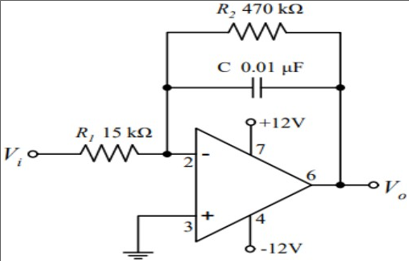
Practical Circuit of Integrator (R = 15 kΩ, Rf = 470 kΩ, C = 0.015 µF, Op-Amp OP07, ±12V supply).
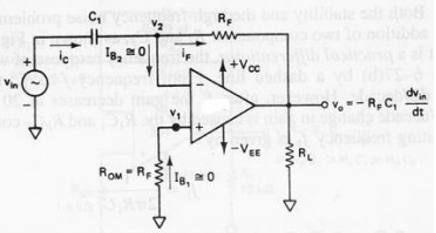
Practical Circuit of Differentiator (capacitor at input, resistor in feedback path).
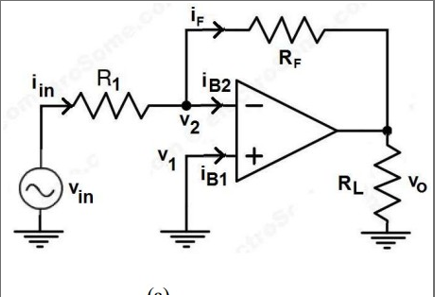
Circuit of Inverting Amplifier (R1 input resistor, Rf feedback resistor, non-inverting terminal grounded).
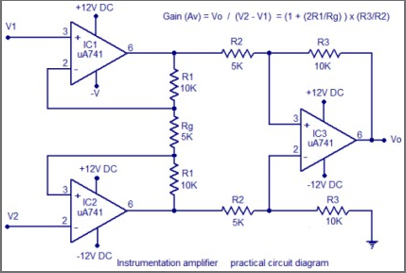
Circuit of Instrumentation Amplifier (three op-amps: two input buffers and one difference amplifier stage).
Procedure
- Assemble the integrator circuit on the breadboard using R = 15 kΩ, Rf = 470 kΩ, and C = 0.015 µF with OP07 powered by ±12V.
- Apply a square wave input from the function generator and observe the output on the oscilloscope.
- Apply a sinusoidal input and observe the output waveform.
- Record and compare input and output waveforms at different frequencies.
- Assemble the differentiator circuit with the capacitor at the input and resistor in the feedback.
- Apply a square wave input and observe the output on the oscilloscope.
- Apply a sinusoidal input and observe the output waveform.
- Record and compare input and output waveforms at different frequencies.
- Assemble the inverting amplifier circuit with appropriate R1 and Rf values.
- Apply a square wave input at 1 kHz and observe the output waveform.
- Increase the frequency to 10 kHz and observe the effect of the op-amp slew rate on the output.
- Apply a sinusoidal input and verify the phase inversion and gain.
- Assemble the three op-amp instrumentation amplifier circuit using IC 741C and resistors.
- Apply an input voltage of 2V Vpp and observe the amplified output on the oscilloscope.
- Calculate the measured gain and verify the amplification behavior based on the resistor values.
Simulation / Execution
Content coming soon...
Observations
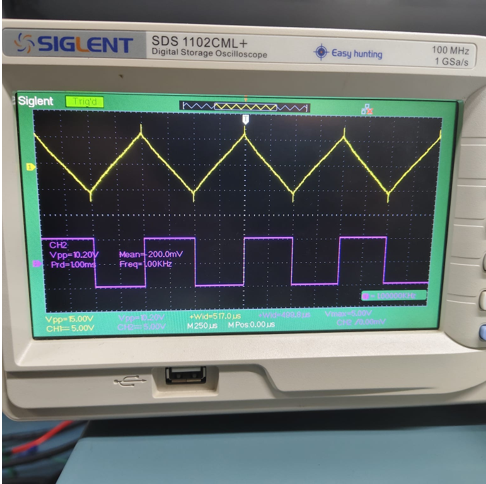
Figure 1(a): Integrator output for Square wave input — output is triangular, consistent with the integration property.
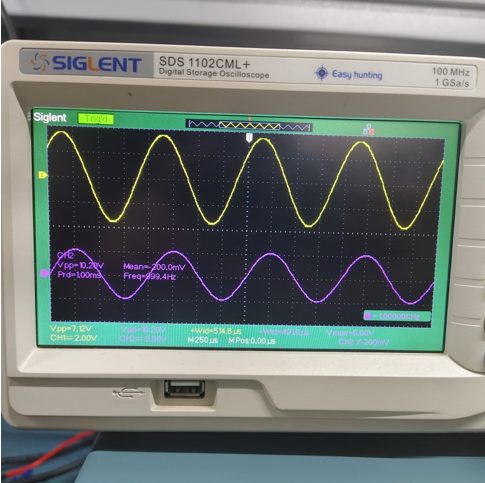
Figure 2(b): Integrator output for Sine wave input — output is a cosine-like waveform shifted by 90°.
- For a square wave input, the output is triangular, consistent with the integration property.
- For a sinusoidal input, the output is a cosine-like waveform shifted by 90°.
- At low frequencies, integration is more precise and the expected waveforms are achieved. At higher frequencies, distortion occurs because the capacitor reactance decreases, weakening the ideal integration effect.
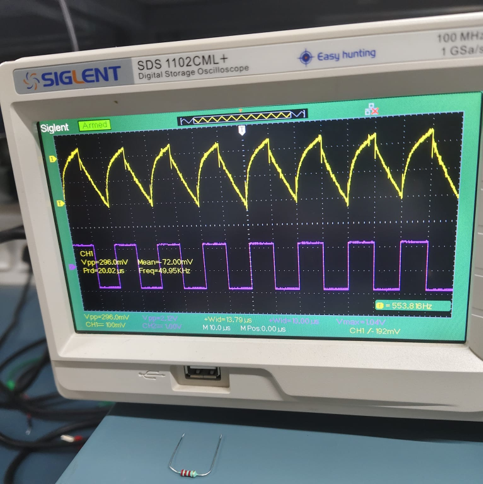
Figure 3(a): Differentiator output for Square wave input — output shows sharp spikes at transitions.
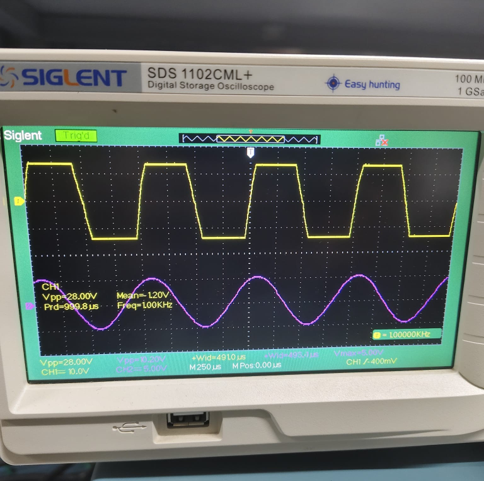
Figure 4(b): Differentiator output for Sine wave input — output is a cosine-like waveform shifted by 90°.
- For a square wave input, the output ideally produces sharp spikes at signal transitions.
- For a sinusoidal input, the output is a cosine-like waveform shifted by 90°.
- In practice, the output differs from the ideal case due to non-ideal op-amp behavior. The finite open-loop gain decreasing with frequency, and the need for stabilization resistors, result in deviations especially at higher frequencies.
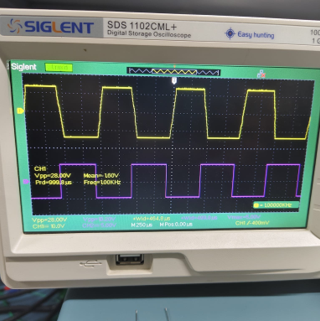
Figure (a): Inverting amplifier output for Square wave input at 1 kHz — clean inverted square wave output observed.
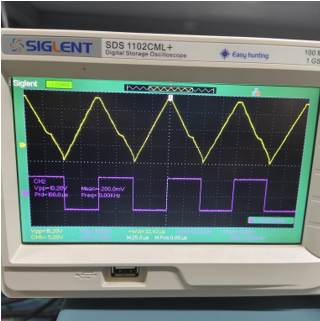
Figure (b): Inverting amplifier output for Square wave input at 10 kHz — output takes triangular shape due to op-amp slew rate limitation.
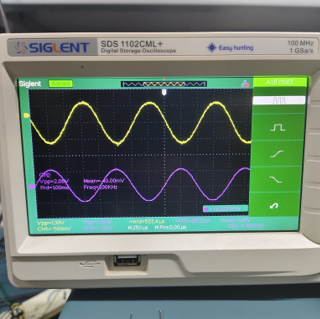
Figure (c): Inverting amplifier output for Sine wave input — clean inverted sine wave with no significant distortion.
- At 1 kHz, the square wave input produces a clean inverted square wave output, as expected.
- At 10 kHz, the output takes the shape of an inverted triangle due to the op-amp slew rate limitation, where the output voltage cannot change fast enough to track the sharp edges.
- For the sine input, the output is a clean inverted sine wave since the frequency is within the op-amp bandwidth.
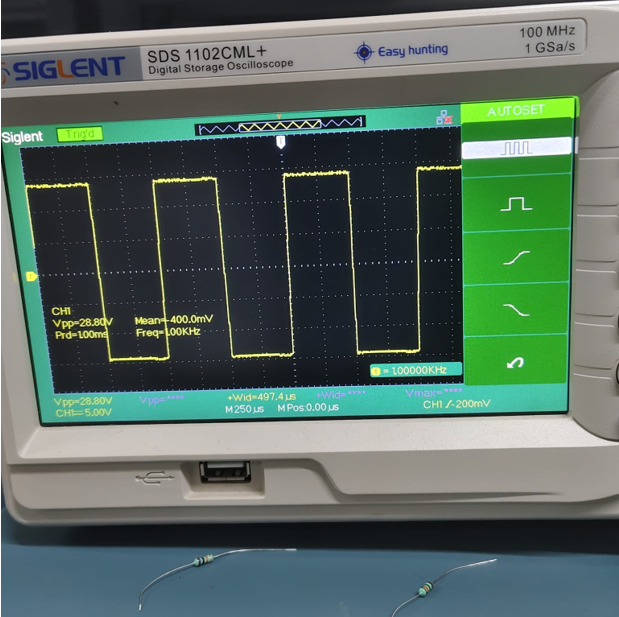
Figure: Output showing amplified signal — Vout = 28.8V Vpp.
Calculations
Results & Analysis
| Circuit | Input | Expected Output | Observed Output |
|---|---|---|---|
| Integrator | Square wave | Triangular wave | Triangular wave (confirmed) |
| Integrator | Sine wave | Cosine wave (90° shift) | Cosine-like wave (confirmed) |
| Differentiator | Square wave | Spike pulses at transitions | Spike-like output (confirmed) |
| Differentiator | Sine wave | Cosine wave (90° ahead) | Cosine-like wave (confirmed) |
| Inverting Amplifier | Square wave @ 1 kHz | Inverted square wave | Clean inverted square wave |
| Inverting Amplifier | Square wave @ 10 kHz | Inverted square wave | Triangular (slew rate limited) |
| Inverting Amplifier | Sine wave | Inverted sine wave | Clean inverted sine wave |
| Instrumentation Amplifier | 2V Vpp | Amplified output | 28.8V Vpp (gain = 14.4) |
- All four op-amp circuits functioned as expected with minor practical deviations.
- The integrator and differentiator outputs matched theoretical waveform transformations at low frequencies.
- The inverting amplifier demonstrated slew rate limitation at 10 kHz, producing a triangular output instead of a square wave.
- The instrumentation amplifier achieved a measured gain of 14.4 based on the resistor configuration.
Conclusion
Post-Lab / Viva Voce
- Q: In a practical op-amp integrator, why is a resistor connected in parallel with the feedback capacitor, and what effect does it have on the ideal integration behaviour?
A: Without the parallel resistor, any small DC offset at the op-amp input gets integrated continuously, causing the output to ramp up until it saturates — this is called integrator wind-up. The parallel resistor Rf provides a DC feedback path that clamps the output and stabilises the circuit. However, it introduces a low-frequency pole at f = 1/(2πRfC), so the circuit behaves as a true integrator only for frequencies well above this pole. Below the pole frequency, it behaves like an inverting amplifier with gain −Rf/R1. - Q: For a triangular wave input to a differentiator, what is the ideal output, and why might the practical output look different?
A: A triangular wave has a constant positive slope for the first half-period and a constant negative slope for the second half-period. Since the differentiator output is proportional to dVin/dt, the ideal output is a square wave — constant positive voltage during the rising ramp and constant negative voltage during the falling ramp, with instantaneous transitions. In practice, the transitions are not instantaneous because the op-amp has a finite slew rate and the practical differentiator includes a small input resistor (in series with the capacitor) which limits high-frequency gain and smooths the edges. - Q: Why does an inverting amplifier present a lower input impedance compared to a non-inverting amplifier built with the same resistor values?
A: In the inverting amplifier, the input signal is applied to the inverting terminal through R1, and the inverting terminal is held at virtual ground by the feedback. Therefore, the input impedance seen by the source is simply R1 — typically a few kilohms. In contrast, the non-inverting amplifier applies the input directly to the non-inverting terminal, which sees the full input impedance of the op-amp itself (typically in the megaohm to gigaohm range). This makes the inverting topology less suitable when the signal source has high output impedance. - Q: What is virtual ground in an inverting op-amp configuration, and under what conditions does it break down?
A: Virtual ground is the condition where the inverting input terminal is maintained at 0 V (same as the non-inverting terminal which is grounded), even though it is not physically connected to ground. It arises because the op-amp has very high open-loop gain: any tiny voltage difference between the terminals produces a large output, which through the feedback resistor drives the inverting terminal back to near zero. Virtual ground breaks down when: (1) the output saturates (hits the supply rail), so the feedback can no longer correct the input; (2) the input frequency exceeds the op-amp's gain-bandwidth product, so the open-loop gain is no longer large enough to maintain the condition. - Q: In the instrumentation amplifier, why is the gain controlled by a single external resistor Rg rather than adjusting multiple resistors as in a simple difference amplifier?
A: In a simple difference amplifier, gain is set by the ratio of resistors across both input and feedback paths. Changing the gain requires changing multiple resistors simultaneously and precisely — any mismatch degrades common-mode rejection ratio (CMRR). In the three-op-amp instrumentation amplifier, the two input buffer op-amps share a single resistor Rg between their inverting terminals. The gain of the input stage depends solely on the ratio 2R/Rg, so adjusting just one resistor changes gain symmetrically for both input channels, preserving CMRR. This makes gain adjustment simple, precise, and non-interactive. - Q: If the output of the differentiator appears noisy even with a clean sinusoidal input, what is the cause and how is it mitigated in a practical design?
A: A pure differentiator has a transfer function H(s) = −RCs, meaning its gain increases linearly with frequency. High-frequency noise present in any real signal is therefore amplified far more than the signal itself, producing a noisy output. This is mitigated by adding a small resistor Rin in series with the input capacitor, which limits the high-frequency gain to −Rf/Rin (a finite ceiling). This turns the circuit into a band-limited differentiator that differentiates accurately up to a frequency of f = 1/(2πRinC) and attenuates noise above it.
References & Resources (Not Applicable)
This section is not required for this experiment.
Was this experiment helpful?
Your feedback helps us improve
Please Sign In to rate this experiment.