Simulation Available
Study of Thermistor Characteristics and Key Performance Parameters
Launch Simulator
Try reducing the supply voltage if temp rise is too rapid.
Aim
To study the Thermistor characteristics and determine key performance parameters:
- Error Analysis – Measurement accuracy assessment
- Non-linearity – Temperature-resistance relationship deviation
- Sensitivity – Response to temperature variations
Apparatus & Software
| Equipment | Purpose |
|---|---|
| Thermistor | Temperature sensitive resistor |
| Hot Plate | Heat source for temperature control |
| Digital Thermometer | Reference temperature measurement |
| Distilled Water | Heat transfer medium |
| Glass Beaker (500 ml) | Container for water bath |
| Digital Multimeter | Resistance measurement |
| Connecting Wires | Electrical connections |
| Breadboard | Circuit prototyping platform |
Theory
A thermistor is a resistor whose resistance varies significantly with temperature. It is a temperature-sensitive semiconductor device which is mostly used for measuring, controlling, and compensating temperature. Thermistors are typically made of metal oxides, designed to provide an observable and predictable change in resistance with change in temperature.
The relation between temperature and resistance for a thermistor is non-linear, which makes it highly sensitive to small changes in temperature within a limited range. Because of this, thermistors are most useful in applications where precise temperature control is required, such as digital thermometers, overcurrent protection circuits, and temperature compensation networks.
Mathematically, the relation is given by:
where R(T) = resistance at absolute temperature T (K), R₀ = resistance at reference temperature T₀ (K), and β = material constant (K).
Sensitivity: The sensitivity of a thermistor is defined as the rate of change of resistance with respect to temperature:
High sensitivity implies that even a slight variation in temperature results in a noticeable resistance change, enabling accurate detection of small temperature fluctuations.
Linearity and Non-Linearity: In an ideal temperature sensor, the resistance and temperature relationship should be linear. However, thermistors have a natural non-linearity, especially over larger temperature ranges. Linearization techniques such as using series or parallel resistors or applying mathematical curve-fitting methods are used to improve measurement accuracy.
Error Considerations: Measurement errors in thermistors may arise due to calibration inaccuracies, environmental disturbances, or the self-heating effect caused by current flow. The percentage error is expressed as:
Full Scale Error (FSE):
where RM = mid-range resistance from thermistor equation, RA = actual measured mid-range resistance, Full Scale = highest observed resistance − lowest observed resistance.
Relative Error (RE):
Pre-Lab / Circuit Diagram
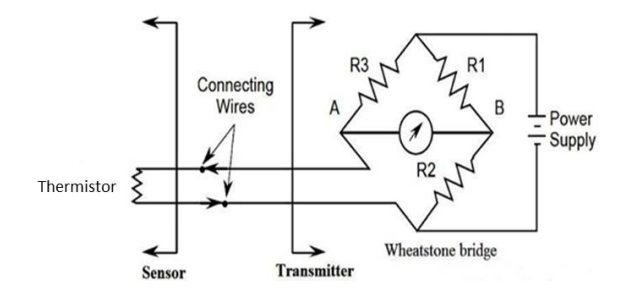
Thermistor incorporated in a Wheatstone bridge circuit for signal conditioning. Output voltage VAB is proportional to the change in thermistor resistance.
Procedure
Part 1 — Thermistor Calibration:
- Fill the glass beaker with distilled water and place it on the hot plate.
- Immerse the thermistor and the digital thermometer in the water bath.
- Heat the water gradually and record the thermistor resistance using the digital multimeter at various temperature points from approximately 24°C to 63°C.
- Record temperature in both °C and K alongside the corresponding resistance values.
Part 2 — Curve Fitting (MATLAB):
- Plot the calibration data (resistance vs temperature) in MATLAB.
- Apply curve fitting using the thermistor equation R(T) = R₀ · exp(β(1/T − 1/T₀)) to determine β and R₀.
- Record the fitted parameters and plot the sensitivity dR/dT vs temperature.
Part 3 — Bridge Circuit Measurement:
- Assemble the Wheatstone bridge circuit with the thermistor as one of the bridge arms.
- Supply Vs = 10V to the bridge and measure the bridge output voltage VAB at each temperature step from 25°C to 64°C.
- Calculate RT and measured temperature from bridge voltage readings.
- Compute full-scale error and relative error for each measurement.
Simulation / Execution
MATLAB was used to plot the calibration curve (resistance vs temperature), perform curve fitting to determine thermistor parameters β and R₀, compute sensitivity dR/dT vs temperature, and plot bridge voltage VAB vs temperature.
Observations
Table 1: Calibration of Thermistor
| S. No. | Temperature (°C) | Temperature (K) | Resistance (Ω) |
|---|---|---|---|
| 1 | 24.0 | 297.15 | 11100 |
| 2 | 27.0 | 300.15 | 9550 |
| 3 | 30.0 | 303.15 | 8720 |
| 4 | 32.0 | 305.15 | 7820 |
| 5 | 34.5 | 307.65 | 6980 |
| 6 | 36.0 | 309.15 | 6690 |
| 7 | 38.5 | 311.65 | 5900 |
| 8 | 41.0 | 314.15 | 5150 |
| 9 | 46.0 | 319.15 | 4260 |
| 10 | 51.0 | 324.15 | 3575 |
| 11 | 53.0 | 326.15 | 3290 |
| 12 | 56.0 | 329.15 | 3050 |
| 13 | 58.0 | 331.15 | 2720 |
| 14 | 60.0 | 333.15 | 2520 |
| 15 | 63.0 | 336.15 | 2395 |
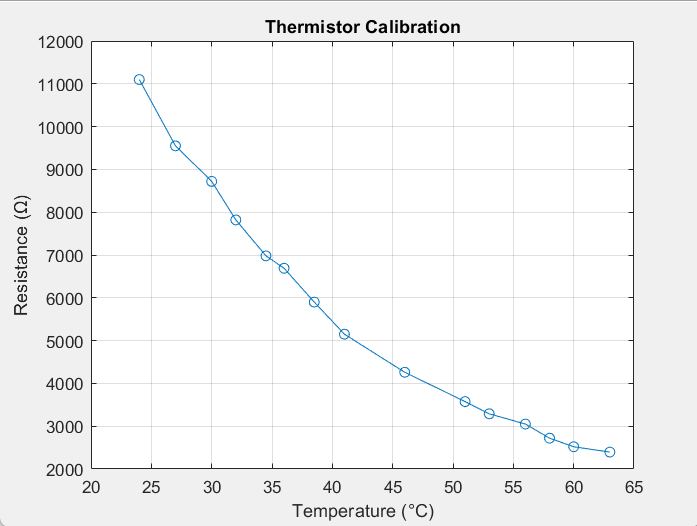
Figure 1: Thermistor Resistance vs Temperature (Calibration Curve) plotted in MATLAB.
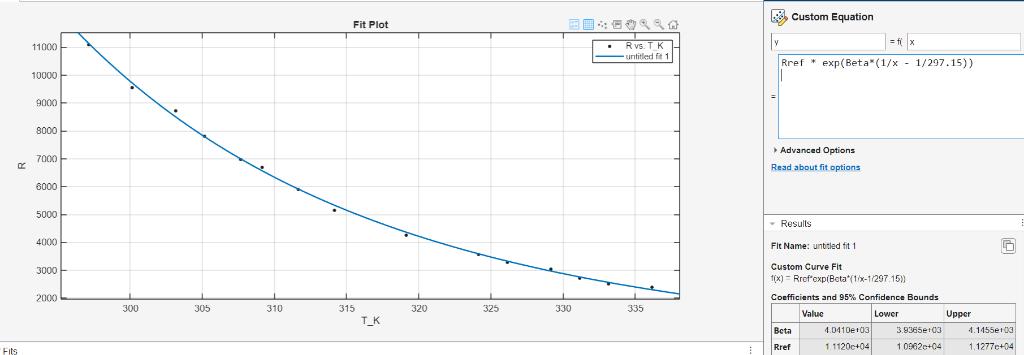
Figure 2: Curve Fitting for Thermistor Parameters using MATLAB. Fitted parameters: R₀ = 11.12 kΩ, β = 4041.0 K.
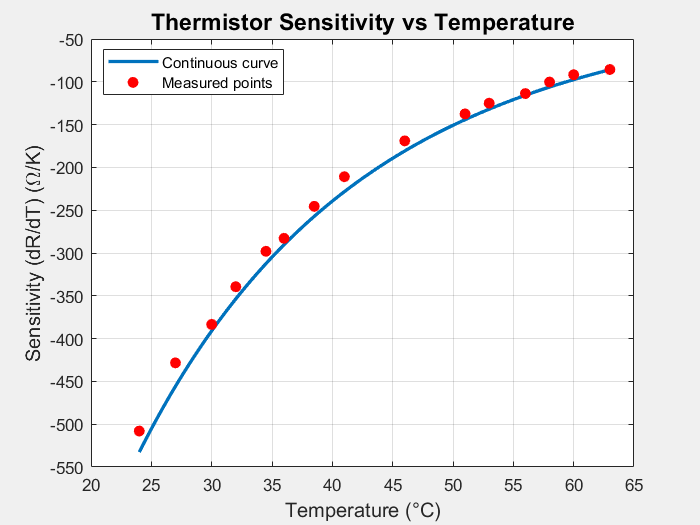
Figure 3: Temperature vs Sensitivity of the Thermistor. Continuous curve = calculated sensitivity; red dots = measured points.
Table 2: Bridge Voltage VAB vs Temperature
| S. No. | Temperature (°C) | Bridge Voltage VAB (V) |
|---|---|---|
| 1 | 25.00 | 2.258 |
| 2 | 28.33 | 2.200 |
| 3 | 30.56 | 2.180 |
| 4 | 33.33 | 2.137 |
| 5 | 36.11 | 2.098 |
| 6 | 38.89 | 2.089 |
| 7 | 41.67 | 2.017 |
| 8 | 44.44 | 1.980 |
| 9 | 47.22 | 1.869 |
| 10 | 50.00 | 1.738 |
| 11 | 52.78 | 1.693 |
| 12 | 55.56 | 1.616 |
| 13 | 58.33 | 1.543 |
| 14 | 61.11 | 1.464 |
| 15 | 63.89 | 1.459 |
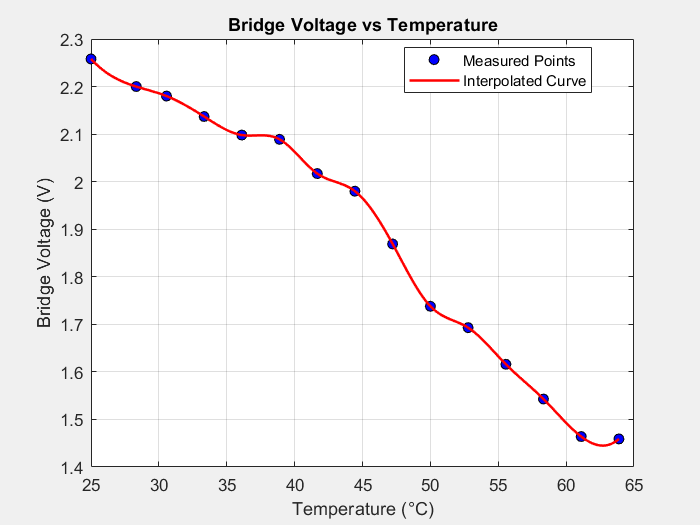
Figure 4: Bridge Voltage VAB vs Temperature plot obtained from MATLAB.
Calculations
Curve Fitted Parameters: R₀ = 11.12 kΩ, β = 4041.0 K
Calibrating and Sensing Equations: Substituting R₀ = 11.12 kΩ, β = 4041 K, T₀ = 298.15 K into the thermistor equation:
Rearranging for the sensing (inverse) equation:
Non-Linearity at Mid Range:
Sensitivity Formula:
Bridge Circuit — Sample Calculation (at Vbridge = 2.258 V):
Final Error Summary (first reading):
Results & Analysis
- Thermistor parameters obtained from curve fitting: R₀ = 11.12 kΩ and β = 4041.0 K.
- The thermistor exhibits a non-linear resistance-temperature relationship, with resistance decreasing from 11100 Ω at 24°C to 2395 Ω at 63°C.
- Sensitivity (dR/dT) is negative and becomes less negative with increasing temperature, indicating decreasing sensitivity at higher temperatures.
- Non-linearity at mid-range: RM = 4995 Ω vs RA = 4705 Ω, giving a relative error of 3.33%.
- Bridge circuit full-scale error ranged from approximately 0.20% to 10.72% across the measurement range.
- Relative error ranged from 0.72% to 16.63%, with larger errors at higher temperature readings.
Conclusion
In this experiment, we successfully carried out the calibration of a thermistor and observed its resistance variation with temperature. We plotted the resistance versus temperature graph and applied curve fitting to determine the thermistor constants R₀ and β. We also found the sensitivity of the thermistor by differentiating the thermistor equation and plotted the sensitivity versus temperature graph. From the results, it can be seen how small changes in temperature affect the resistance of the thermistor. Finally, we implemented a bridge circuit to measure temperature vs voltage variations and compared the thermistor measured temperature with actual temperature values. Full-scale and relative errors were calculated for all readings based on the measured and actual resistance values. Overall, the experiment provided hands-on experience on thermistor behavior, curve fitting, and error analysis.
Post-Lab / Viva Voce
- Q: Why does a thermistor have a much higher sensitivity than an RTD, yet RTDs are preferred in precision industrial applications?
A: A thermistor's sensitivity (dR/dT) is given by −(β/T²)RT, which is large because β is typically 3000–5000 K and resistance values are high (kilohms). However, this high sensitivity comes at the cost of severe non-linearity — the exponential R-T relationship means the sensitivity itself changes dramatically with temperature, making accurate measurement over a wide range difficult without linearisation. RTDs, by contrast, have low but nearly constant sensitivity (≈0.385 Ω/°C for Pt-100) and an approximately linear R-T relationship, allowing direct, accurate measurements over a wide range without complex correction algorithms. - Q: In the thermistor equation R(T) = R₀ exp(β(1/T − 1/T₀)), what physical meaning does the constant β carry, and how does its value affect the sensor's behaviour?
A: β is the material constant of the thermistor (units: Kelvin) and is related to the activation energy of the semiconductor material: β = Ea/k, where Ea is the activation energy and k is Boltzmann's constant. A higher β means the resistance changes more steeply with temperature — the sensor is more sensitive but also more non-linear. A lower β gives a flatter, more linear response but less sensitivity. β also sets the temperature range over which the thermistor is most useful; sensors are typically characterised for a specific range around T₀. - Q: What is the self-heating effectself-heating effectThe rise in temperature of a sensor or device caused by the power dissipated by the measurement current passing through it, leading to measurement error. in a thermistor, and how does it introduce measurement error?
A: When current flows through the thermistor for resistance measurement, it dissipates power P = I²R as heat within the thermistor element itself. This raises the thermistor's temperature above the ambient temperature it is supposed to be measuring, causing it to report a lower resistance (for NTC) than the true ambient value. The error increases with measuring current and is worse at higher resistances (low temperatures) where more power is dissipated. It is minimised by using the smallest measurement current that still gives an acceptable signal-to-noise ratio, or by using pulsed excitation. - Q: Why is a Wheatstone bridge used for thermistor signal conditioning rather than simply measuring resistance directly with a voltage divider?
A: A simple voltage divider output is proportional to R/(R + Rref), which is a non-linear function of R and does not easily allow differential measurement. The Wheatstone bridge produces a differential output voltage that is approximately zero when the thermistor is at the reference temperature (balanced condition), and produces a small differential signal proportional to the change in resistance. This null-balance approach allows very small resistance changes to be detected against a near-zero background, making it much easier to amplify only the temperature-dependent signal without amplifying a large common-mode DC level. - Q: The experiment calculates both full-scale error and relative error. What different information does each metric convey, and in which situation would each be more important?
A: Full-scale error (FSE = (RM − RA)/RFS) expresses the error as a fraction of the total measurement range. It indicates how significant the error is relative to the instrument's span and is most relevant when evaluating a sensor for a specific measurement range — a large FSE means the sensor is inaccurate relative to what it is supposed to measure. Relative error (RE = (RM − RA)/RA) expresses the error as a fraction of the actual reading at that point. It is most relevant for evaluating accuracy at a specific operating point, especially in applications where the sensor operates at a fixed or narrow temperature range. - Q: If the curve-fitted β value from MATLAB is 4041 K but the datasheet specifies β = 3950 K for the same thermistor, what are the likely reasons for this discrepancy?
A: Several factors can cause this: (1) Component-to-component variation — thermistors have manufacturing tolerances, and individual units can differ from the nominal datasheet value. (2) The datasheet β is typically specified over a standard range (e.g., 25°C to 50°C or 25°C to 85°C), while the experiment spans 24°C to 63°C — a different fitting range will yield a different β. (3) The simplified two-parameter model (R₀ and β) is itself an approximation of the more accurate Steinhart–Hart three-parameter model; fitting errors can shift the apparent β. (4) Calibration errors in the thermometer used as the temperature reference also affect the fitted result.
References & Resources (Not Applicable)
This section is not required for this experiment.
Was this experiment helpful?
Your feedback helps us improve
Please Sign In to rate this experiment.